Renovation & Structural Restoration
An old building does not always need demolition; in most cases it needs an honest diagnosis first. Cosmetic shrinkage cracks are not structural movement, and a tired surface is not a frame that has lost capacity — the difference between the two is the difference between a successful renovation and money spent in the wrong direction. We breathe new life into aging buildings — from structural strengthening and facade restoration to full interior refurbishment and system upgrades — and we always start with a technical assessment before any decision.
- Repair & strengthening of cracked concrete structures — or deteriorated ones.
- CFRP carbon fiber column reinforcement — with concrete jacketing where required.
- Injection systems for active cracks.
- Building facade renovation & repainting — with re-cladding within the same scope.
- Full interior refurbishment to modern standards.
- MEP system repair & upgrade — plus crack repair, waterproofing and sealing.
Diagnosis before demolition
Every renovation starts with a technical assessment: what is structural, what is cosmetic, and what will fail next if ignored. Clients receive a clear report separating urgent structural work from optional upgrades — with costs for each. In that order you know where the first pound must go and what can be safely deferred, instead of discovering it mid-execution.
Structural strengthening that restores capacity
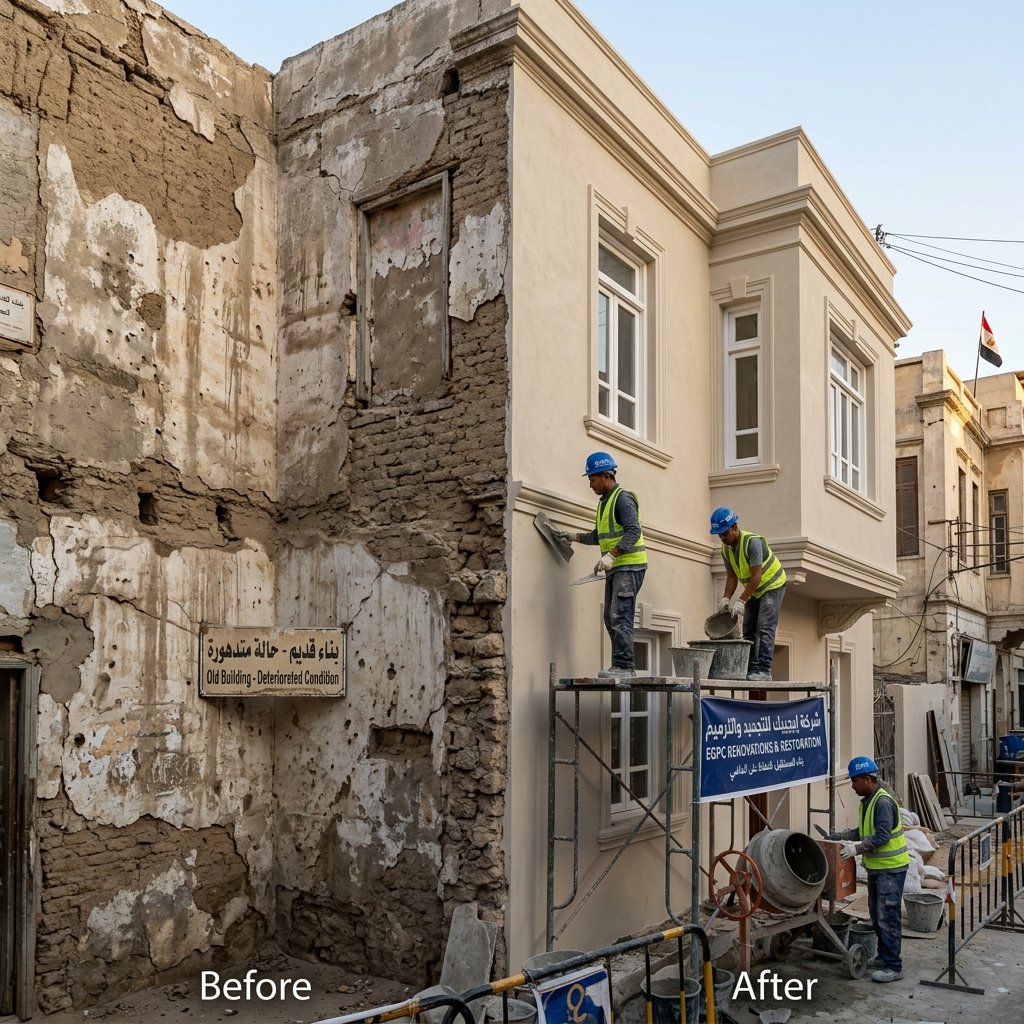
We repair and strengthen cracked or deteriorated concrete using proven methods including CFRP carbon fiber reinforcement for columns, jacketing where required, and injection systems for active cracks — executed under engineering supervision with before/after documentation. Photographic documentation before and after the intervention is not a formality: it is the owner's and their engineer's reference for what was actually executed inside the concrete.
Full refurbishment, one team
Facade restoration, interior refurbishment to modern standards and MEP upgrades run as one coordinated scope, so the building comes back once — not trade by trade over years. For occupied or operating buildings, the works are managed with phased plans that keep residents or operations running safely.
How to compare renovation offers
Compare scope by scope, not price by price: does the offer start from a documented technical assessment? Does it separate urgent structural works from optional upgrades, with costs for each? Does it name the strengthening method (injection, jacketing, carbon fiber) and its justification? Does it include before/after documentation? A cheap offer that jumps straight to "finishing" over a structural problem sells you twice: once for cosmetics and once for repairing what should have been treated first.
Signs your building needs a structural assessment
- Cracks wider than a few millimeters or widening over time, especially diagonal ones at opening corners.
- Visible settlement or tilt in floors or levels.
- Exposed rebar rust with spalling of the concrete cover.
- Persistent damp or salinity in foundations or slabs.
- Previous undocumented modifications: a cut beam or an opening added without calculation.
Any of these signs is not a final verdict — it means a technical assessment is the right next step before any spending.
When renovation is not the answer
Renovation is not the answer for every deteriorated building: when defects are severely structural across most elements, or the foundations were never adequate for the required loads, or the strengthening cost approaches the cost of rebuilding to newer standards, demolition and rebuilding may be the sounder technical and economic decision. Good practice presents this comparison honestly in the technical assessment — renovation cost and expected life against the alternatives — instead of assuming renovation is always cheaper. The right decision builds on the building's actual condition and its future usage requirements, and is studied case by case.
Common renovation mistakes
- Cosmetics over structure: painting over active cracks hides the symptom and leaves the cause working.
- Injecting cracks before stopping their source: good practice treats the cause first, then repairs the effect.
- Strengthening without before/after documentation: without documentation neither the owner nor their engineer can verify what was executed inside the concrete.
- Restoring the facade before treating the damp source: the wrong order brings the problem back with the first winter.
Execution steps
- Technical site assessment: separating urgent structural work from optional cosmetic upgrades.
- A written report with recommendations and the cost of each item — the decision stays with the owner, on clear figures.
- Structural strengthening works first where required (CFRP, jacketing, injection).
- Facade restoration, interior refurbishment and systems upgrade as one coordinated scope.
- Before/after documentation and item-by-item handover.
Frequently Asked Questions
How do I know if cracks in my building are dangerous?
Book a site assessment. Our engineers distinguish cosmetic shrinkage cracks from structural movement and advise on recommended actions. (existing — kept as-is)
Can an old building be strengthened without demolition?
In most cases, yes. Techniques like CFRP reinforcement and concrete jacketing restore capacity with minimal removal. (existing — kept as-is)
Do you renovate occupied buildings?
Yes, with phased plans that keep residents or operations running safely. (existing — kept as-is)
When is injection the answer and when is strengthening?
Good practice treats active cracks with injection systems after stopping their cause, while loss of capacity in structural elements is treated with strengthening (carbon fiber or jacketing). Only the technical assessment settles the choice.
Does the technical report commit me to execute with you?
The report explains the condition, the recommendations and the cost of each item; the execution decision and its scope remain the owner's.
What is the difference between concrete jacketing and CFRP carbon fiber?
Jacketing adds a reinforced concrete shell around the existing element, increasing its section and capacity; carbon fiber wraps the element and strengthens it with small thickness and limited removal. The choice between them is the technical assessment's decision, by the element's condition, position and site constraints.
Does full renovation take longer than new construction?
It depends on the building's condition and the scope of works; the technical assessment is what turns the question from a guess into a program built on a documented scope.
Can renovation be executed in phases by budget?
Each case is studied on its own; the safe rule is to execute urgent structural works first, then defer optional upgrades in an order that does not waste what was completed.
Does every crack need structural strengthening?
No. Surface cracks in plaster are common and treated locally; wide or repeated diagonal cracks at columns and beams call for a structural assessment before any treatment. The assessment — not the crack's appearance alone — decides the difference; cosmetic treatment of a structural crack hides the symptom and lets the cause worsen.