
How to Choose the Perfect Marble for Your Living Room
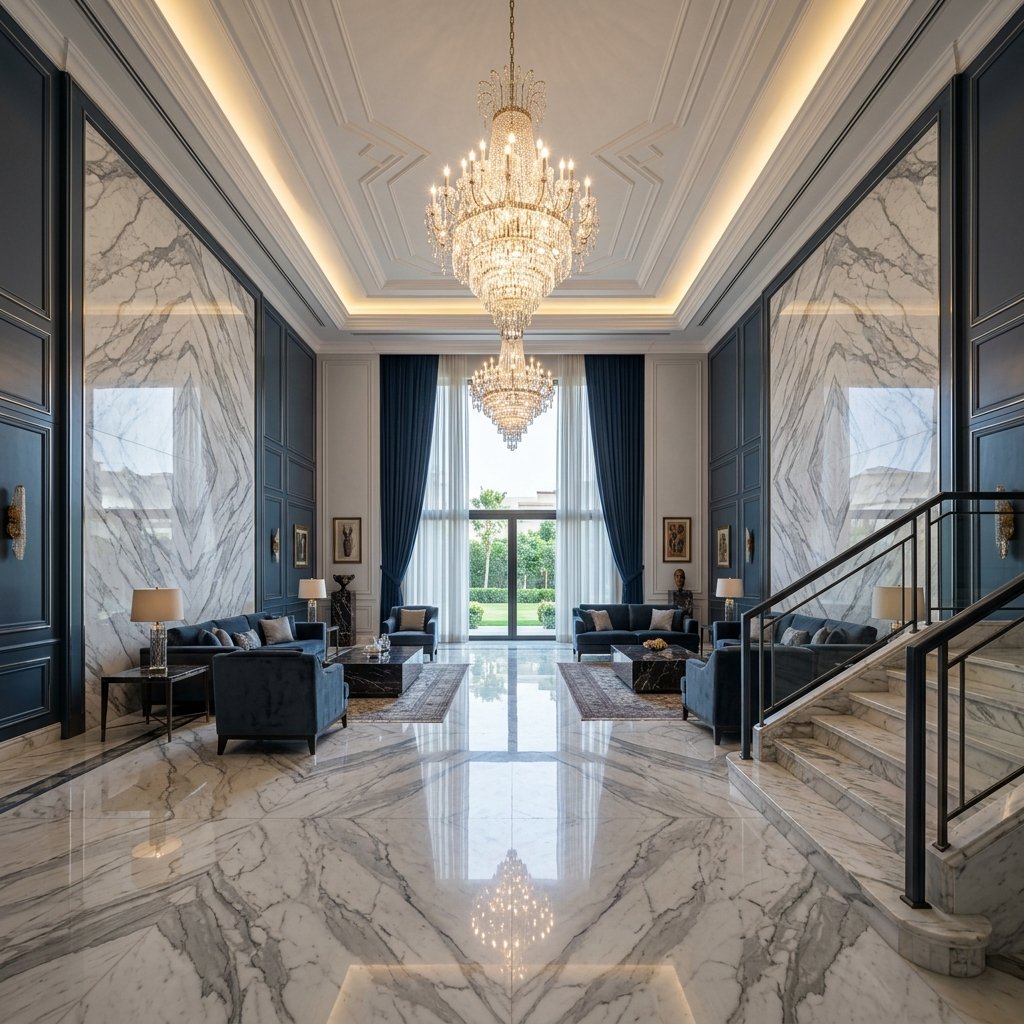
Marble is usually the single most visible material in a finished living room — and the one owners most often choose from a small showroom tile, then meet again at full scale with mixed feelings. This guide walks through the main varieties used in Egypt and the practical checks that separate a floor you love from a floor you tolerate.
The imported classics: Calacatta and Statuario
Calacatta and Statuario are premium Italian white marbles. Calacatta is known for its warm white background and bold, dramatic veining in gold and grey; Statuario carries a brighter, cooler white with finer, more linear grey veins. Both are statement materials: they look their best in large formats with book-matched or continuously-matched slabs, and both sit at the top of the price range. In Egypt they are typically reserved for reception areas, feature walls and master spaces.
The warm middle: Crema Marfil
Crema Marfil, the well-known Spanish beige marble, is the workhorse of elegant interiors: warm, calm, forgiving of dust between cleanings, and easier to match across batches than strongly-veined whites. For family living rooms that must stay beautiful under real daily use, it is often the most practical 'luxury' choice.
Egyptian varieties: value with character
Egyptian marbles — the Galala, Sunny and Silvia families are the best known — offer warm beige and cream tones at a fraction of imported prices, with the logistical advantage of local quarry supply. Quality varies by quarry and selection grade, so slab-by-slab inspection matters more than the variety name. Selected well, Egyptian marble delivers excellent results in family areas and secondary spaces, freeing budget for imported stone where it shows most.
Five checks before you sign the order
- See full slabs, not samples: veining and color only reveal themselves at slab scale.
- Ask for the selection grade in writing: the same variety is sold in multiple grades at very different prices.
- Check thickness and calibration: consistent thickness is what allows a flat, lippage-free floor.
- Plan the layout: a good installer dry-lays or digitally plans vein direction and book-matching before cutting.
- Agree the finish: polished, honed or brushed behave very differently under light and foot traffic.
Installation is half the result
Even the finest slab fails on a poor substrate: the base must be level, sound and dry; bedding mortar must be full-coverage; and joints must be tight and consistent. At Al Mansour we treat substrate preparation and dry-layout as part of the marble scope itself — because the difference between 'marble installed' and 'marble installed beautifully' is decided before the first slab is glued.